





 Order samples
  For architects


 My account
  Wishlist
  Deutsch
  Dansk
Dansk  Română



To measure as accurately as possible and make the best decision, we recommend that you consider the following:
- always use a metal tape measure that is rigid enough so that it does not buckle at great lengths for existing fastening systems
- measure the length of the rod or track
- the height (drop) of the curtain should be equal to or shorter by one centimeter than the height (drop) of the drapery
- in general, the curtain will be made as one whole part, and the draperies in two equal parts
- the total length of the curtain will be calculated as follows:
- for patterned curtains = 2 x the length of the rod/track
- for plain curtains = 2.5 x the length of the rod/track
- the total length of the drapery will be calculated as follows = 2 x the length of the rod/track
- in the case of wooden rods, measure the height of each rod (some wooden rods have height differences between the front rod for draperies and the back U-rod/track for the curtain)
- try to make a sketch as accurate as possible, noting all dimensions
- always order the total length of the curtain or draperies, according to the calculations in your sketch!
How do I measure the size of a curtain or drapery in the case of an existing rod?
- Always measure the length of the rod between its decorative ends
- We recommend that you measure the height (drop) of the curtain/drapery from under the fastening rings on the rod to one of these options, according to your wishes (see the drawing below):
- to the floor + 20 cm if you want it to sit on the floor (we recommend this height only in the case of draperies) – option C
- 1-2 cm above the floor (option D)
- 5-10 cm below the windowsill, where possible, or 5 cm above the radiator (option E)
- 1-2 cm above the windowsill (option F)
How do I measure the size of a curtain or drapery in the case of a rod that will be mounted later
- If a new rod is to be mounted, measure the length of the window, to which add between 15 cm and 30 cm on each side of the window, this measure representing the length of the future rod.
- The height (drop) of the curtain/drapery is measured as follows: measure 15 cm above the window opening or half the distance between the window opening and the ceiling (if this distance is greater than 30 cm and you want to give the idea of height to the room). From this chosen point, we recommend that you measure with the tape measure as follows:
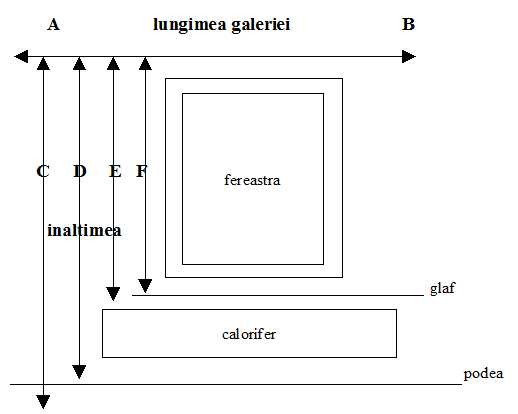
C = height from the rod to the floor + 20 cm if you want the drapery to sit on the floor
D = height from the rod to above the floor by 1-2 cm
E = height from the rod to below the windowsill or to above the radiator
F = height from the rod to above the windowsill by 1-2 cm
Note: always measure the height in at least 3 different points; if there are large differences between the heights taken, choose the shortest height. Or ask us for advice!
How do I measure the size of a curtain or drapery in the case of a track (mounted or to be mounted later)?
- Always measure the length of the mounted track or, if it is mounted later, the desired length, taking into account 15-30 cm on each side of the window opening and various impediments (walls, furniture, plants, etc.). If you want to mount the track from wall to wall, measure the length between the walls.
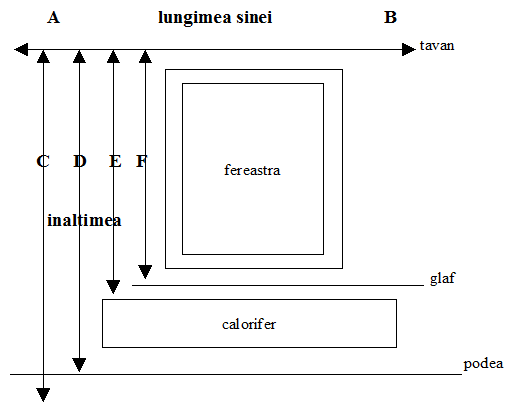
- We recommend that you measure the height (drop) of the curtain/drapery from the top of the ceiling to:
- to the floor + 20 cm if you want it to sit on the floor (we recommend this height only in the case of draperies) – option C
- 1-2 cm above the floor (option D)
- 5-10 cm below the windowsill, where possible, or 5 cm above the radiator (option E)
- 1-2 cm above the windowsill (option F)
C = height from the ceiling to the floor + 20 cm if you want the drapery to sit on the floor
D = height from the ceiling to above the floor by 1-2 cm
E = height from the ceiling to below the windowsill or to above the radiator
F = height from the ceiling to above the windowsill by 1-2 cm
Note: always measure the height in at least 3 points, from left to right; if there are large differences between the heights taken, choose the shortest height. Or ask us for advice!
How do I measure the size of a Roman shade that is mounted inside the window opening
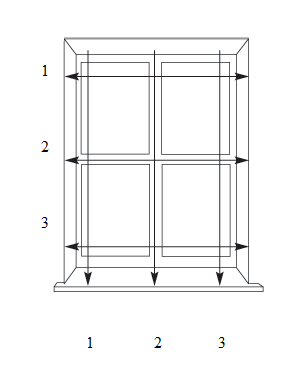
In this case, measure the height of the window opening in at least three points; the same for the width of the system. Take into account all dimensions and choose the smallest value of height and width.
Note: When deciding to mount a Roman system in the window opening, take into account the opening mode of the window, the distance between the window profile and the side walls, the necessary length to tighten the system in the upper part, allowing the window to open, etc.
The variant mounted outside the window opening is much more used, being much more practical.
How do I measure the size of a Roman shade that is mounted outside the window opening
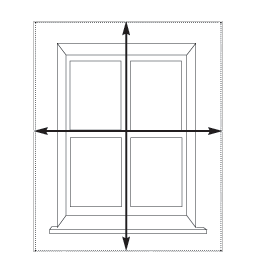
Measure the width of the window opening and add 10 cm on each side, left and right; this is the width of the Roman shade.
The height of the shade is measured as follows: the height of the window opening to which is added 25 – 30 cm above the opening necessary for the shade to be tightened, so as to allow the window to open, and below the window opening measure to where you want the shade to fall (taking into account what exists: windowsill, radiator, floor, etc.)
Many of the windows have two or more sashes; in this case, try to distribute the shades taking into account their number, as well as the opening mode of the window/windows.
How do I measure the size of a Japanese panel
The width of a Japanese panel can vary between 50 and 70 cm (optimally 60 cm). Usually, these panels slide on a track with at least 3 channels, mounted in the ceiling. To find out the height of the panel, measure the distance between the ceiling and where you want the panel to fall.
As much as possible, we recommend that the panel fall to 1-2 cm above the floor, for a more pleasant appearance.
The number of panels is found by dividing the length of the track by the length of the panel + 1 panel (for example, if the track is 300 cm, the number of panels is 5, but we recommend adding at least one additional one, for optimal window coverage). You can also use a single model of material or you can combine two materials (curtain/curtain or curtain/drapery).
It’s all up to your imagination!
How do I measure the size of a bedspread
If you have chosen the draperies for a room and you want a bedspread that matches them, you can choose an identical or similar material in terms of model, shade, texture or color. For this, measure the dimensions of the mattress and add as follows:
- to the width: on each side of the bed, left-right, how much you want the bedspread to fall, adding an extra 5-10 cm so that the bedspread sits loosely on the bed
- to the length: how much you want to go under the pillows, preferably 20-30 cm, and if the bed does not have a lower edge (the part at the feet), to be the same drop as the width
For example: for a bed of 160/200:
width = 160cm mattress + 20cm left drop + 20cm right drop + 10cm for looseness = 210 cm
length = 200cm mattress + 40cm at pillows + 20cm drop at feet + 10cm looseness = 270 cm
If you want it to fall from one side to the other to the floor, measure the height of the bed on each side to which you add the width of the mattress and 5-10 cm for looseness. The same for length, to the length of the mattress add the height of the bed and how much you want to go under the pillows (attention: no more than 270 cm, the materials generally have 280 cm from which the hems are subtracted!)
How do I measure for atypical windows (inclined, curved, etc)
In this case, please contact us by phone or by email at office@perdele-online.ro, trying to describe the atypical window as adequately as possible.
Do not forget: because you are responsible for the quality of the measurements made, try to do this as well as possible.
We are not responsible for defective measurements or for calculation errors regarding the necessary material. If you need our advice, do not hesitate to contact us. According to the company’s policy and the laws in force, materials ordered by the meter or those ordered for a certain fastening system cannot be returned!